Jorge Zárate / October 2025
Strategic Management for Travel and Tourism Leaders
Introduction: A Lifelong Journey Informed by Strategy
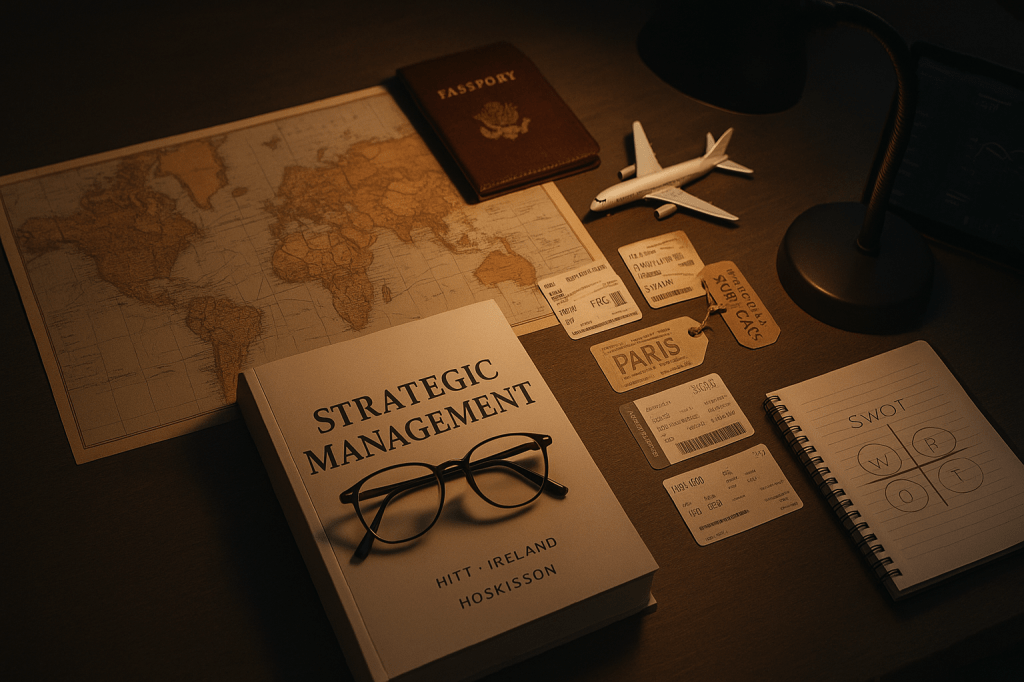
After thirty-five years devoted to the vibrant, challenging, and ever-evolving travel and tourism industry, I have witnessed booms, busts, disruptions, and transformations. From the dawn of the internet to the recent global pandemic, I have learned that success in this sector is not merely a product of passion or luck, but the result of deliberate, insightful, and well-executed strategy. It is with this hard-earned perspective that I have turned to one of the most respected texts in the field of business strategy, Strategic Management: Competitiveness and Globalization, Concepts and Cases by Hitt, Ireland, and Hoskisson. My purpose is clear: to analyze and translate their comprehensive strategic management process into a practical playbook for my peers and successors in travel and tourism.
This article is the culmination of that effort. It moves beyond academic theory to provide a actionable framework for travel agents, tour operators, hoteliers, destination managers, and all tourism professionals. The volatile and interconnected nature of our global industry demands a disciplined approach to navigate competition, leverage globalization, and secure lasting success. By applying the integrated model from Hitt et al. (2021) to the specific contexts we face daily, we can move from being reactive participants to proactive, strategic architects of our own destinies. Consider this a manual,a guide built on proven strategic principles and decades of industry experience,designed to equip you with the tools not just to survive, but to thrive and become a successful agent of change in the world of travel.
The Integrated Strategic Management Process: A Blueprint for Tourism
Hitt et al. (2021) present strategic management as an integrated, ongoing process rather than a series of disconnected exercises. This process model, which flows from analysis to action to outcomes, is perfectly suited to the interconnected nature of tourism. The model begins with a rigorous analysis of strategic inputs, leading to the formulation and implementation of strategic actions, all with the goal of achieving strategic outcomes,primarily, strategic competitiveness and above-average returns.
Part 1: Strategic Inputs – Analyzing the Terrain
The first phase involves a clear-eyed assessment of the internal and external environments, a foundational step for any tourism enterprise.
External Analysis
A comprehensive external analysis examines the general, industry, and competitor environments. The general environment, often analyzed through a PESTEL (Political, Economic, Socio-cultural, Technological, Environmental, Legal) framework, is particularly volatile for tourism.
- Political & Economic: Visa regulations, geopolitical stability, and trade policies can open or close markets overnight. Economic factors like inflation, exchange rates, and disposable income directly dictate travel propensity. A tour operator specializing in luxury travel to Europe, for instance, must constantly monitor currency fluctuations and economic forecasts in key source markets like North America and Asia.
- Socio-cultural: The rise of the “experience economy,” where consumers value unique, authentic, and Instagram-worthy moments over material goods, is a dominant trend (Pine & Gilmore, 1999). There is also a growing demand for transformative travel, where the goal is personal growth and cultural immersion. Furthermore, the increasing awareness of overtourism is pushing destinations and companies to consider more responsible models.
- Technological: This is a primary disruptive force. The ascendancy of Airbnb disrupted the hotel industry, while Google Travel and Booking.com consolidated immense power in the distribution channel. Emerging technologies like Artificial Intelligence (AI) for personalized travel planning, the Internet of Things (IoT) for smart hotel rooms, and virtual reality for destination previews are reshaping the customer journey from inspiration to post-trip sharing.
- Environmental: Climate change is a dual-edged sword. It poses a physical threat to low-lying coastal resorts and ski destinations, while simultaneously driving demand for sustainable and low-impact travel options. The flight-shaming movement and consumer preference for businesses with strong environmental, social, and governance (ESG) credentials are becoming significant factors.
The heart of external analysis is the industry environment, best understood through Michael Porter’s Five Forces model (Porter, 1980).
- Threat of New Entrants: Barriers to entry can be low for online travel agencies (OTAs) or small tour guides, but are exceptionally high for airlines or large cruise lines due to capital requirements and regulation.
- Bargaining Power of Buyers: The power of individual travelers has never been greater, thanks to price-comparison websites and social media reviews. Large corporate travel departments also wield significant power in negotiating rates.
- Bargaining Power of Suppliers: This is high for key assets. Airlines are dependent on aircraft manufacturers (Boeing, Airbus) and constrained by limited airport slots. Hotels are at the mercy of global distribution systems (GDS) and OTAs for customer acquisition.
- Threat of Substitute Products: Videoconferencing is a substitute for business travel. A “staycation” or a local experiential purchase can substitute for a distant vacation.
- Rivalry Among Existing Competitors: Fierce, often based on price, as seen in the constant price wars between airlines and OTAs.
Internal Analysis
While the external environment presents opportunities and threats, the internal environment reveals a firm’s strengths and weaknesses. The Resource-Based View (RBV) of the firm, a central concept in Hitt et al. (2021), argues that competitive advantage stems from possessing valuable, rare, inimitable, and non-substitutable (VRIN) resources and capabilities.
For a tourism company, these can be tangible, such as a fleet of new, fuel-efficient aircraft or a prime beachfront property. However, sustainable advantage more often lies in intangible resources:
- Human Capital: A highly trained, empathetic staff that delivers exceptional service can be a powerful differentiator for a hotel chain or a tour company.
- Brand Reputation: Brands like Four Seasons or Abercrombie & Kent have built reputations for quality and exclusivity that are difficult for competitors to replicate.
- Intellectual Property: Proprietary booking algorithms, unique itineraries, or patented technology.
- Organizational Culture: A culture of innovation and agility, as seen in companies like Airbnb, which allows them to pivot and adapt quickly to market changes.
A SWOT analysis (Strengths, Weaknesses, Opportunities, Threats) is a useful tool to synthesize the findings from the internal and external analyses, creating a clear strategic picture.
Part 2: Strategic Actions – Formulating and Executing the Plan
With a clear understanding of the strategic inputs, a firm can formulate its strategic actions.
Business-Level Strategy
This concerns how a firm competes in a specific market or industry segment. Hitt et al. (2021) outline the generic strategies of cost leadership, differentiation, and focus.
- Cost Leadership: This strategy involves being the low-cost producer in the industry. Ryanair and EasyJet are quintessential examples in the airline sector. They achieve this through a no-frills service model, standardized fleets, and aggressive cost control on everything from airport fees to staff costs. In tourism, large OTAs like Booking.com also compete on cost (or rather, price) by offering the broadest inventory and leveraging scale to secure competitive rates.
- Differentiation: This strategy involves creating a product or service that is perceived as unique industry-wide. The Ritz-Carlton Hotel Company differentiates itself through its legendary service and “Gold Standards.” Intrepid Travel differentiates by offering small-group, sustainable, and culturally immersive adventures that are distinct from mass-market tours. Differentiation allows a company to command a premium price.
- Integrated Cost Leadership/Differentiation: This hybrid approach, increasingly common, is enabled by technology. For instance, Virgin Atlantic attempts to offer some differentiated, stylish amenities while maintaining a competitive cost structure on its routes.
Use Case 1: “EcoLodge Andes” – Differentiation through Sustainability
Imagine “EcoLodge Andes,” a small hotel in Peru. Its external analysis reveals a strong opportunity in the growing market for sustainable travel and a threat from larger, conventional resorts. Its internal analysis identifies key strengths: a unique, remote location, deep partnerships with local communities, and authentic expertise in the local ecology (VRIN resources).
Its strategic action is a focused differentiation strategy. It targets a specific segment of travelers,affluent, environmentally conscious ecotourists. It formulates its strategy around its unique value proposition: unparalleled access to nature with a minimal environmental footprint. This is executed through:
- Structure: A flat, empowered organizational structure where local guides are key decision-makers.
- Controls: Rigid environmental controls (e.g., zero single-use plastic, closed-loop water systems) monitored and reported transparently.
- Strategic Leadership: A leader who is both a savvy businessperson and a genuine conservation advocate, ensuring the strategy is authentically embedded in the culture.
By doing so, EcoLodge Andes avoids direct price competition with large resorts and builds a loyal customer base willing to pay a premium for its unique, values-aligned experience.
Corporate-Level Strategy
This concerns the question, “What businesses should we be in?” For diversified tourism conglomerates, this involves decisions about portfolio management.
- Related Diversification: Creating value through economies of scope and sharing activities across business units. The TUI Group is a prime example. It owns airlines, hotels, cruise ships, and tour operators. This vertical and horizontal integration allows TUI to control the entire customer experience, capture revenue at multiple points, and cross-sell services, creating synergies that a standalone company cannot easily match.
- Unrelated Diversification: This involves operating businesses that are not related, creating value primarily through financial economies. This is less common in pure tourism but could involve a hotel chain owning an unrelated real estate development arm.
International Strategy
Given its inherently global nature, the choice of international strategy is critical for tourism firms. Hitt et al. (2021) discuss the balance between global integration and local responsiveness.
- Global Standardization: Seeking cost reduction through standardized operations worldwide. Marriott International employs this to a large degree, ensuring a consistent level of quality and service across its global portfolio, which creates efficiency and builds brand trust.
- Multi-domestic Strategy: Emphasizing customization to fit local markets. A smaller tour company might use this strategy, tailoring its offerings in Japan (e.g., more group-oriented, meticulous itineraries) versus those in Australia (e.g., more independent, adventure-focused).
- Transnational Strategy: The ideal, but difficult-to-achieve balance of global efficiency and local responsiveness. Airbnb attempts this: it has a globally standardized platform and brand, but its offerings are hyper-local (unique homes and experiences) and it must navigate vastly different local regulations in each market.
Use Case 2: “GlobalAir” – Navigating the Turbulence of International Strategy
“GlobalAir,” a hypothetical full-service carrier, faces intense pressure from Gulf carriers (global cost leaders) and regional low-cost carriers. Its external analysis shows high supplier power (aircraft manufacturers) and intense rivalry. Internally, its strengths are a strong brand and a valuable portfolio of landing slots at a major hub airport.
Its strategic action involves a multi-domestic partnership strategy. Recognizing it cannot compete globally on cost alone, it forgoes a pure global standardization model. Instead, it joins a global airline alliance (e.g., Star Alliance) to gain global reach and feed traffic through its hub. Simultaneously, it forms deep codeshare and joint venture partnerships with key airlines in specific geographic markets (e.g., a partner in Asia, another in South America). This allows GlobalAir to offer seamless global networks (achieving some global integration) while allowing its partners to handle local marketing, sales, and customer service, ensuring local responsiveness. This collaborative approach, leveraging strategic alliances, is a key tool for competing in the capital-intensive airline industry.
Part 3: Strategic Outcomes and the Critical Role of Implementation
Formulating a brilliant strategy is futile without effective implementation. This involves the nuts and bolts of organizational structure, controls, and strategic leadership.
- Organizational Structure: A rigid, hierarchical structure will stifle the innovation required in today’s tourism market. Companies are moving toward flatter, more organic structures that empower frontline employees,the hotel concierge, the flight attendant,to solve customer problems creatively. For a large conglomerate like TUI, a multidivisional structure is necessary to manage its diverse portfolio.
- Controls: Strategic controls are subjective and concerned with the long-term effectiveness of the strategy (e.g., is our brand perception improving?). Financial controls are objective and focus on short-term performance (e.g., revenue per available room). A balanced scorecard that includes both financial metrics and non-financial indicators like customer satisfaction, employee engagement, and environmental impact is essential.
- Strategic Leadership: The leaders of tourism firms must be visionaries who can navigate complexity and foster an entrepreneurial culture. They are responsible for making the critical resource allocation decisions,should we invest in a new AI platform or renovate our flagship hotel? They must also manage the firm’s portfolio of resources and build an effective organizational culture. The success of companies like Airbnb can be directly attributed to the strategic leadership of its founders, who envisioned and executed a disruptive new model for travel accommodation.
Use Case 3: “Heritage City Tourism Board” – Implementing a Destination Management Strategy
A city known for its UNESCO World Heritage site faces the strategic outcome of overtourism: declining resident quality of life, damage to monuments, and a poor visitor experience,a clear failure to achieve sustainable competitiveness. The strategic input analysis reveals the threat is existential.
The city’s strategic action is to implement a comprehensive destination management strategy. The formulation involves policies like visitor caps, timed ticketing, and promoting off-season travel. However, the implementation is the true challenge.
- Structure: A new public-private governance structure is created, bringing together hotels, tour operators, transport companies, and resident associations.
- Controls: New strategic controls are implemented, shifting the key performance indicator from pure visitor numbers to metrics like average visitor expenditure, dispersal to lesser-visited neighborhoods, and resident satisfaction scores.
- Strategic Leadership: The mayor and tourism board CEO provide the leadership to build consensus among often conflicting stakeholders (hoteliers wanting more tourists vs. residents wanting fewer). They must communicate the long-term vision of a sustainable, high-quality destination, even if it involves short-term pain.
The strategic outcome, achieved through diligent implementation, is the transition from a volume-based to a value-based tourism model, ensuring the city’s cultural and economic longevity.
Conclusion: Your Strategic Playbook for the Future
The travel and tourism industry stands at a critical juncture. The forces of globalization, technological disruption, and environmental change are not temporary disruptions but permanent features of the landscape. In this environment, the integrated strategic management process championed by Hitt, Ireland, and Hoskisson provides an indispensable roadmap for success. It demands that managers move beyond reactive tactics and embrace a disciplined cycle of analysis, formulation, and execution. From the boutique EcoLodge crafting a focused differentiation strategy to the global airline navigating complex international alliances, the principles remain the same: understand your environment, leverage your unique resources, and build an organization capable of turning strategy into reality.
This is the core of the playbook. Use it to conduct your own rigorous analysis. Use it to choose a clear competitive position rather than getting stuck in the middle. Use it to forge strategic alliances that amplify your reach. Most importantly, use it to lead with vision and execute with precision. For those who master this process, the reward is not merely survival, but the ability to thrive and shape the future of travel, achieving strategic competitiveness that is both profitable and sustainable. Let this manual be your guide as you write your own success story in the next chapter of our incredible industry.
References
Hitt, M. A., Ireland, R. D., & Hoskisson, R. E. (2021). Strategic management: Competitiveness and globalization: Concepts and cases (13th ed.). Cengage Learning.
Pine, B. J., & Gilmore, J. H. (1999). The experience economy: Work is theatre & every business a stage. Harvard Business School Press.
Porter, M. E. (1980). Competitive strategy: Techniques for analyzing industries and competitors. Free Press.
 Jorge Zárate